
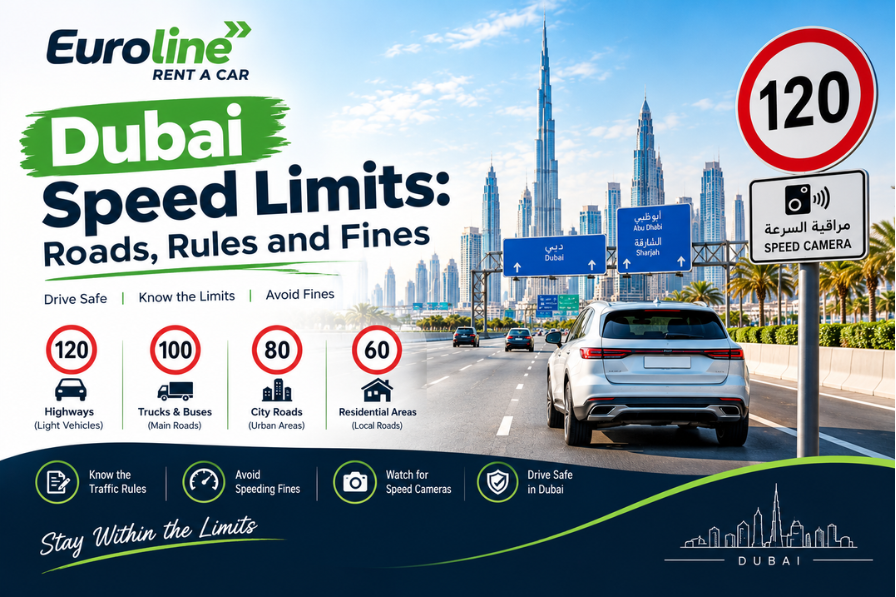
Dubai has some of the smoothest roads in the world, and some of the most closely watched. Cameras are everywhere, limits can change from one section of road to the next, and fines add up fast. If you are visiting, or renting a car for the first time, knowing the speed limits in Dubai is one of the easiest ways to protect your holiday budget and your safety.
In this guide, we explain Dubai speed limits by road, how speeding fines in Dubai work, what the 2026 rules mean for drivers and renters and how to avoid trouble. Planning a trip? Browse our economy car rental options with free delivery in Dubai.
Rent a Car in Dubai | Ask on WhatsApp
|
Road type |
Typical speed limit |
|
Residential streets and low-speed zones |
25 to 40 km/h |
|
City roads |
60 to 80 km/h |
|
Main arterial roads |
80 to 100 km/h |
|
Major highways |
100 to 120 km/h |
|
Some highway sections |
Up to 140 km/h |
The golden rule: The sign you see is the limit. Limits change often, and many roads use electronic signs that update with traffic and weather, so always follow the sign in front of you, not what you remember from yesterday.
Here is a guide to the main roads visitors use. Limits can vary by section, so treat this as a general guide and follow the signs.
|
Road |
What to expect |
|
Sheikh Zayed Road (E11) |
Mostly 100 to 120 km/h, with lower limits in busy sections near Downtown and the Trade Centre |
|
Sheikh Mohammed bin Zayed Road (E311) |
Highway speeds, up to 120 km/h and 140 km/h in some sections |
|
Emirates Road (E611) |
Highway speeds, up to 120 km/h and 140 km/h in some sections |
|
Al Khail Road and Airport Road |
Arterial roads, generally 80 to 100 km/h |
|
Jumeirah Beach Road and city roads |
Usually 60 to 80 km/h, with lower limits near beaches and crossings |
|
Dubai Marina, JBR and residential areas |
Low-speed zones, often 25 to 40 km/h and sometimes up to 60 km/h |
|
School zones and car parks |
Very low limits. Slow down and watch for children |
Always check the signs. Limits can change between sections, and temporary limits apply during roadworks, bad weather and low visibility.
Many Dubai roads use electronic signs that change the limit in real time. This happens during:
Heavy traffic
Fog and low visibility
Rain and wet roads
Roadworks and accidents
Fog is common in winter mornings. Limits are lowered for safety, and radars apply the new limit straight away. Check the overhead signs often, especially on highways.
Speeding fines in Dubai are issued automatically by radar cameras, and the amount rises with how fast you were going over the limit. The table below shows the typical schedule reported for 2026.
|
Speed over the limit |
Fine |
What else can apply |
|
Up to 20 km/h |
AED 300 |
|
|
21 to 30 km/h |
AED 600 |
|
|
31 to 40 km/h |
AED 700 |
Black points may apply |
|
41 to 50 km/h |
AED 1,000 |
Black points may apply |
|
51 to 60 km/h |
AED 1,500 |
Black points and possible vehicle impoundment |
|
61 to 80 km/h |
AED 2,000 |
12 black points and impoundment (reported up to 30 days) |
|
More than 80 km/h |
AED 3,000 |
23 black points and impoundment (reported up to 60 days) |
Guides differ slightly on some amounts, points and impound days, and penalties can change. Check the latest figures with Dubai Police.
Other speed-related fines:
Driving below the minimum speed in a lane with a minimum limit: reported at about AED 400 and black points.
Sudden braking and tailgating: Separate fines apply, and are often linked to high-speed driving.
Black points are penalty points added to your driving record for serious offences, including heavy speeding.
Points stay on the record for a period (reported as one year).
Collecting too many can lead to a driving licence suspension.
Very serious offences can lead to vehicle impoundment as well as points.
If you are a visitor, your home licence may not carry the points, but you still pay the fines, and serious offences can lead to bigger consequences.
You may read that Dubai allows about 20 km/h over the posted limit before cameras flash. Some guides report this, while others say cameras can trigger at lower speeds, and Abu Dhabi is reported to have no buffer at all. Do not rely on any buffer. It is not guaranteed, it can change without notice and it does not make speeding legal. The safest plan is simple: drive at or below the posted limit.
If you are planning a day trip, remember that each emirate enforces its own roads.
Abu Dhabi: Reported to enforce the posted limit strictly, with no buffer. Highway limits and signs can differ from Dubai. Read our guide on why Land Rover suits UAE roads for tips on the drive.
Sharjah: Follow local signs and enforcement. Read our guide to free parking in Sharjah and see our Sharjah car rental page.
Between emirates: Limits can change when you cross the border, so watch for new signs.
Fines are linked to the car's number plate, not to a person at the time. In a rental car, this is what usually happens:
The camera records the offence and the fine goes to the car's registered owner, the rental company.
The rental company identifies the renter from the contract.
The fine is charged to the renter, sometimes with an administration fee, which depends on the company.
Serious offences can lead to vehicle impoundment, with extra costs for the renter.
At Euroline, traffic fines are paid by the renter and are not included in the rental price. Other extra charges include Salik toll charges (AED 4 per gate), fuel, accident charges, extra kilometers, VAT and late return charges. Always ask our team about how fines are handled when you book.
Good to know: Unpaid fines can cause problems later, including when leaving the country. It is best to settle any fine promptly.
Dubai Police website and app: Check fines by plate number, driving licence or traffic file number.
RTA services: Some fines and parking violations can be checked through RTA channels.
Your rental company: Ask for the fine details and the payment method.
Watch the signs, not your memory. Limits change often.
Use cruise control on highways to hold a steady speed.
Use a navigation app that shows the current speed limit.
Slow down in new areas, school zones, roadworks and near junctions.
Leave early. Rushing leads to speeding.
Take extra care in powerful cars. Sports cars and big SUVs reach high speeds very quickly, so check your speed often.
Follow weather warnings. Reduce speed in fog, rain and dust.
Keep to the right unless overtaking, and do not drive too slowly in fast lanes.
Remember Salik gates. Slowing suddenly near toll gates can cause accidents.
Plan your route in advance so you are not distracted by a wrong turn.
Whatever you drive, you are responsible for the speed. Some options from our fleet:
Easy and economical: The Citroen C4 and Omoda C5 start from AED 150 per day. Also see our cheap car rental page.
Comfortable highway cruisers: The Audi A6 and the 2025 Cadillac Escalade feel smooth at highway speeds.
Powerful supercars: The Ferrari F8 Spider reaches high speeds very quickly. Enjoy it within the limits and consider our Ferrari rental guide.
Family trips: Read our best cars for families guide or the 7 seater car rental page.
Driving costs more than the rental price, so see UAE petrol prices today to plan your fuel budget.
✔ Free delivery and collection anywhere in Dubai
✔ Insurance included on most vehicles
✔ 250 km daily mileage allowance
✔ Daily, weekly and monthly rental plans
✔ 24/7 customer support through WhatsApp and phone
Tourists: passport, visit visa and a valid driving licence (an international driving licence can be arranged for an extra charge).
UAE residents: passport copy, residence visa, valid UAE driving licence and Emirates ID.
The minimum rental age at Euroline is 18.
Call: +971 52 711 1134
WhatsApp: Chat with us now
Email: Info@euroline-rental.com
Online: Contact Us
Learn more about Euroline, explore our services or read more on our blog.
What is the speed limit in Dubai?
It depends on the road. Residential streets are about 25 to 40 km/h, city roads 60 to 80 km/h, main arterial roads 80 to 100 km/h and highways 100 to 120 km/h, with up to 140 km/h on some sections. Always follow the signs.
What is the speed limit on Sheikh Zayed Road?
Mostly 100 to 120 km/h, with lower limits in some sections. Check the signs.
What is the highest speed limit in Dubai?
Up to 140 km/h on certain highway sections, such as parts of the E311 and E611.
How much is a speeding fine in Dubai?
From AED 300 for going up to 20 km/h over, rising to AED 3,000 for the most extreme speeding, which can also bring black points and vehicle impoundment.
Is there a speed buffer in Dubai?
Some guides report about 20 km/h, but it is not guaranteed and can change. Do not rely on it. Drive at or below the posted limit.
What are black points?
Penalty points added to your driving record for serious offences. Too many can lead to a licence suspension.
Who pays the speeding fine in a rental car?
The renter. At Euroline, traffic fines are paid separately from the rental price.
How can I check my fines?
Use the Dubai Police website or app with your plate, licence or traffic file number, or ask your rental company.
We reply instantly on WhatsApp
English / العربية
👋 Hello, I need assistance with your car rental service.
English / العربية
🌟 Marhaba, I need assistance with your car rental service.
Russian / English
Привет, I need assistance with your car rental service.





.png)